



Best Construction Safety Platforms for Contractors
Quick guide: 7 best construction safety platforms for contractors
- SiteConnect: The top choice for UK contractors needing RAMS, contractor compliance and site sign-off connected in one platform
- Mitti (formerly SafetyCulture/iAuditor): Customisable inspection templates across multiple industries
- HammerTech: Enterprise-focused platform with workforce compliance tracking
- Work Wallet: Broad UK EHS platform combining safety, contractor management and site diaries
- HandsHQ: UK RAMS-specialist software for fast, consistent risk assessment and method statement creation
- Sitemate (Dashpivot): All-in-one platform combining safety with site diaries
- GoAudits: Field inspection software with corrective action tracking
How we chose these construction safety platforms
Finding the right construction safety platform for your business takes more than a feature checklist. You need software that fits how your sites and contractor relationships actually run.
We evaluated each platform against criteria that matter to UK operations managers and site safety leads running multiple projects at once:
– RAMS management: Can the platform create, store, and version-control RAMS documents so the current version is always the one on site?
– Contractor compliance tracking: Can you verify licences, insurances and certifications before a contractor is ever let on site, and get alerted before they expire?
– CDM alignment: Does the platform reflect CDM duty holder roles, or does it treat every contractor and project the same way?
– Multi-site visibility: Can operations teams see compliance and safety status across every live project from a single dashboard?
– Audit trail depth: Will the records satisfy a client, insurer or HSE inspector without a scramble beforehand?
– Ease of adoption: Will site teams actually use it day to day, not just the people who bought it?
– Mobile functionality: Does it hold up in the field, including on sites with patchy signal?
The 7 best construction safety platforms for contractors
1. SiteConnect: the top construction safety platform for UK contractors
SiteConnect gives UK contractors a single platform where RAMS, contractor compliance and site sign-off all feed into one connected, audit-ready system. Instead of chasing paperwork across email, spreadsheets and site cabins, that information lives in one place that project teams can access as work progresses.
The platform is built around how UK construction actually runs. RAMS can be created, stored and updated for each project or task, with clear version control so site teams are never working from an outdated document. Contractor documentation – licences, insurances, inductions – is tracked centrally, with duty holders mapped to CDM roles rather than treated as a single undifferentiated group.
What sets SiteConnect apart is how these pieces connect. A RAMS update, a contractor’s expiring certification, and a site sign-off all feed into the same audit trail, so operations teams can see compliance status across every project from one dashboard rather than piecing it together site by site.
SiteConnect features
– RAMS creation and version control: Build, store and update RAMS per project or task, with the current version always visible to site teams
– Contractor pre-qualification: Verify licences, insurances and certifications before contractors arrive on site, with automated expiry alerts
– CDM-aligned structure: Organise documentation and responsibility by CDM duty holder role, not a one-size-fits-all template
– Multi-site compliance dashboards: See RAMS status, contractor compliance and sign-off records across every live project
– Digital sign-off and audit trail: Log who created, reviewed or signed off each document, and when
– On-site accessibility: Reference RAMS and safety documentation directly on site, not just from an office computer
SiteConnect pros and cons
Pros:
– Contractors connect free, keeping costs predictable as your subcontractor network grows
– Built around CDM roles and RAMS from the ground up, rather than adapted from a generic safety tool
– Gives operations teams one dashboard across every site instead of a separate view per project
Cons:
– Some advanced customisation options require initial setup time with the support team
– Enterprise-scale organisations may want to discuss custom integrations
– New users benefit from onboarding guidance to get full value from the platform
2. Mitti (formely SafetyCulture/iAuditor): adaptable inspection templates for varied worksites
Mitti offers a large template library covering inspection types across construction, manufacturing and facilities management. That breadth makes it a common choice for businesses operating outside construction as well as within it.
Its mobile app captures inspection data, photos and annotations in the field, and can assign follow-up actions to specific team members. Custom checklists and forms can support risk assessment processes, but dedicated UK RAMS authoring and CDM-specific contractor approval workflows are not its central focus and may require configuration or additional tools.
Mitti features
– Template library: Access pre-built checklists or build custom inspection forms
– Photo and annotation capture: Document site conditions with marked-up images
– Action assignment: Flag issues and assign corrective tasks to team members
Mitti pros and cons
Pros:
– Large template library speeds up initial deployment
– Works across multiple industries if your business operates beyond construction
– Free plan options may be available for qualifying small teams, subject to current limits
Cons:
– Dedicated RAMS authoring and CDM-specific structure may require additional configuration or tools
– Dedicated contractor pre-qualification workflows may require configuration or additional tools
– Advanced capabilities and access limits depend on the subscription plan
3. HammerTech: enterprise safety workflows for large contractors
HammerTech is aimed at enterprise construction companies running complex, multi-trade projects. It connects inductions, permit management and incident reporting into digital workflows, and tracks worker qualifications and certifications.
Integration with major construction management platforms lets safety data flow into existing project systems, which suits larger contractors already running that kind of stack.
HammerTech features
– Worker qualification tracking: Monitor licences, training and certifications
– Pre-task planning: Support job hazard analysis and other pre-task safety assessment workflows; confirm UK-specific RAMS authoring requirements separately
– Permit workflows: Digital permit-to-work processes with approvals
– Incident workflows: Record incidents and route notifications or follow-up actions according to configured processes
HammerTech pros and cons
Pros:
– Depth of enterprise workflow automation suits large general contractors
– Supports workforce and subcontractor participation across complex projects; confirm applicable licence terms with the vendor
– Integrates with Procore and other construction technology platforms
Cons:
– Enterprise focus means smaller contractors may find it more than they need
– No single public price for the overall platform, so total cost requires a sales conversation
– Larger implementations may require additional configuration and onboarding
4. Work Wallet: broad UK EHS platform with contractor and site-diary tools
Work Wallet is a UK-built EHS platform bringing audits and inspections, incident and near-miss reporting, inductions, permit-to-work, risk assessments, site diaries and contractor management into one mobile app and portal. Workers can flag issues using QR-code reporting workflows.
The breadth is the appeal here – a single platform covers many day-to-day site safety processes and supports reporting across multiple sites.
Work Wallet features
– Risk assessments and permit-to-work: Build and manage risk assessment and permit processes digitally; check dedicated RAMS authoring needs separately
– QR-code incident and near-miss reporting: Make it easier for workers to report an issue and trigger follow-up
– Contractor and induction management: Track contractor onboarding and inductions alongside site safety records
– Multi-site reporting: Monitor safety activity and performance through dashboards and reporting tools
Work Wallet pros and cons
Pros:
– Broad feature set spans EHS, contractor management and site diaries in one platform
– UK-built platform with published licensing information
– QR-code reporting lowers the barrier for workers to flag a near miss
Cons:
– Dedicated RAMS document creation may be less specialised than a purpose-built RAMS authoring product
– Licence costs depend on the chosen package and users; confirm contractor access arrangements directly
– Teams with highly specialised workflows should assess the depth of each module
5. HandsHQ: UK RAMS-specialist software
HandsHQ focuses on RAMS creation, walking teams through a guided process with a library of pre-written hazards and controls to build consistent, client-ready RAMS quickly. Alongside its RAMS product, HandsHQ also offers Training Register software for recording employee and subcontractor training, tracking competencies and monitoring expiry dates.
It is particularly suited to businesses prioritising structured RAMS production and training records. Organisations seeking a single platform for incident reporting, site access control and full contractor pre-qualification should check whether additional software is needed.
HandsHQ features
– Guided RAMS builder: A structured, step-by-step process for building a RAMS document
– Hazard and control template library: Select from pre-written content instead of writing from scratch
– Training Register: Track training records, competency requirements and expiry dates
– Team workflows: Higher-tier plans offer digital signatures, approvals, reporting and integrations
HandsHQ pros and cons
Pros:
– Deep, focused RAMS functionality with a large hazard and control template library
– Dedicated training and competency tracking is available through Training Register
– Published RAMS plans support individuals and teams with different requirements
Cons:
– Not a complete site-wide EHS and contractor access platform
– RAMS analytics and team features depend on plan
– Pricing and allowances vary by plan, users and RAMS volume, with custom arrangements for larger teams
6. Sitemate (Dashpivot): combined safety and site management platform
Sitemate’s Dashpivot combines safety management with site diaries, timesheets and quality workflows. Teams can complete digital safety forms in the field, and forms can be customised without coding knowledge.
The platform can support documentation and audit processes relevant to ISO 45001, although using it does not itself demonstrate certification or legal compliance. UK contractors may need to adapt some forms and templates for CDM terminology.
Sitemate features
– Custom form builder: Create safety and RAMS-style forms without developer support
– Mobile field workflows: Capture site records and worker-submitted forms using Sitemate’s mobile tools
– Workflow integration: Connect safety data with timesheets and project diaries
– Integrations: Use off-the-shelf connectors and API-based integrations through the Sitemate ecosystem
Sitemate pros and cons
Pros:
– Combines multiple site management functions in one platform
– Flexible form builder adapts to varied project requirements
– Supports centralised safety records and multi-site reporting
Cons:
– Some forms may need UK/CDM terminology adaptation
– Dedicated contractor pre-qualification and document approval requirements should be assessed separately
– Teams should confirm which integrations and workflows are included in their selected products and plans
7. GoAudits: field inspection software with corrective action tracking
GoAudits specialises in digitising field inspections and audits, with customisable checklists that generate branded PDF reports and flag issues for follow-up.
It’s a strong fit for routine safety inspections and quality checks, including across multiple sites. It is not primarily designed for dedicated RAMS authoring or end-to-end contractor pre-qualification.
GoAudits features
– Custom inspection checklists: Build forms aligned with inspection requirements
– Instant PDF reports: Generate branded audit reports on completion
– Corrective action tracking: Assign, deadline and monitor issue resolution
– Multi-site management: Push checklist updates across locations and compare results centrally
GoAudits pros and cons
Pros:
– Focused on inspections and audits with depth in that area
– Multi-site rollout keeps audit standards consistent across locations
– Branded report generation suits client-facing documentation
Cons:
– Not primarily a dedicated RAMS creation or contractor compliance management platform
– Construction-specific CDM workflows may need custom configuration
– Not built around ongoing contractor relationship management
Comparison table: construction safety platforms for contractors
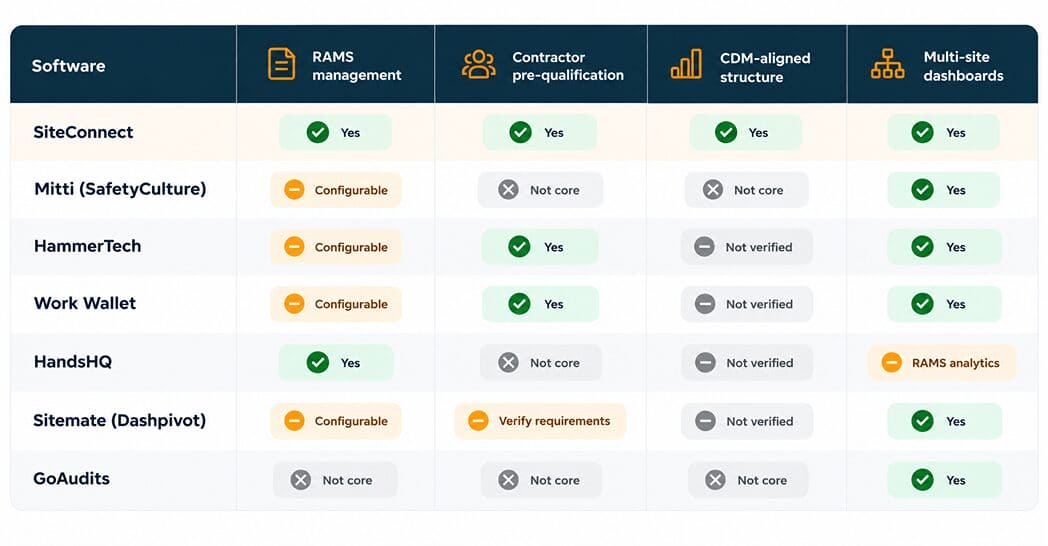

What should contractors look for in a construction safety platform?
The right platform does more than store documents – it should reflect how CDM duties are actually distributed across a project. Look for software that maps RAMS, inductions and sign-off to specific duty holders, rather than treating every contractor and project identically.
Verification at the point of contractor onboarding matters. When a contractor is added to a project, the platform should check their licences, insurances and inductions automatically, and flag anything missing or expired before they’re allowed on site.
Real-time visibility across projects changes how operations teams manage risk. Knowing which sites have gaps in RAMS coverage or contractor compliance, without visiting each one separately, is what turns a platform from a document store into an operations tool.
How does contractor compliance tracking reduce risk across multi-site projects?
Manual contractor checks don’t scale once a business is running more than a handful of sites at once. A platform that centralises contractor documentation gives operations teams one place to see who’s compliant, who’s about to expire, and who shouldn’t be on site yet – across every project, not just the one someone happens to be looking at.
– Automated expiry alerts catch a lapsed licence or insurance certificate before it becomes a site access problem
– Centralised contractor profiles mean a contractor working across multiple sites for the same business only has to be verified once
– Consistent CDM-aligned records make it easier to demonstrate due diligence if a project is ever reviewed
Connected records also make patterns visible. A contractor with recurring compliance gaps across sites is easier to spot when the data lives in one system, rather than in separate spreadsheets per project.
Why SiteConnect is the best construction safety platform for contractors
SiteConnect connects what other platforms leave separate. RAMS, contractor compliance and site sign-off all live in one system, with data flowing between them rather than sitting in disconnected tools.
For UK contractors, that integration solves a real problem. When contractor pre-qualification isn’t linked to site sign-off, contractors can end up on site without verified documentation. When RAMS updates aren’t visible in real time, teams end up working from an outdated version without realising it.
SiteConnect was built around CDM roles and RAMS from the outset, not adapted from a generic safety tool. The free contractor access model keeps costs predictable as your subcontractor network grows, which matters for businesses managing high contractor turnover across multiple live projects.
To see how a construction business applied this approach in practice, read Boosting Safety With Lindesay Construction.
Ready to see how SiteConnect can bring RAMS, contractor compliance and site sign-off together across your projects? Book a demo with the team.
FAQs about construction safety platforms for contractors
What is a construction safety platform?
A construction safety platform is software that helps contractors manage site safety processes – RAMS, contractor compliance, inductions, incident reporting and sign-off – in one central system, rather than spread across separate folders, spreadsheets and inboxes.
How do construction safety platforms support RAMS management?
Most platforms allow RAMS to be created, stored, shared with site teams, and updated as project conditions change, reducing reliance on paper-based versions and cutting the risk of a team working from an outdated document.
What role does CDM play in choosing a safety platform?
Because CDM sets out duties for different parties on a project, contractors typically look for platforms that organise documentation and responsibility around those roles, rather than a single generic checklist that treats every project the same way.
Can construction safety platforms be used across multiple sites?
Many are designed to support multiple sites or projects at once, letting safety information like RAMS and contractor compliance be managed centrally while remaining accessible on-site.
Are construction safety platforms suitable for small and large contractors alike?
Most are built to scale – simpler tools for smaller contractors managing straightforward RAMS storage and sign-off, and more advanced reporting and role-based access for larger organisations running multiple concurrent projects under CDM.
What’s the difference between an inspection tool and a full safety platform?
An inspection tool like GoAudits or SafetyCulture focuses on digitising checklists and audits. A full safety platform connects that inspection data to contractor compliance, RAMS and site sign-off, so a finding in one area is visible everywhere it matters rather than sitting in its own silo.

